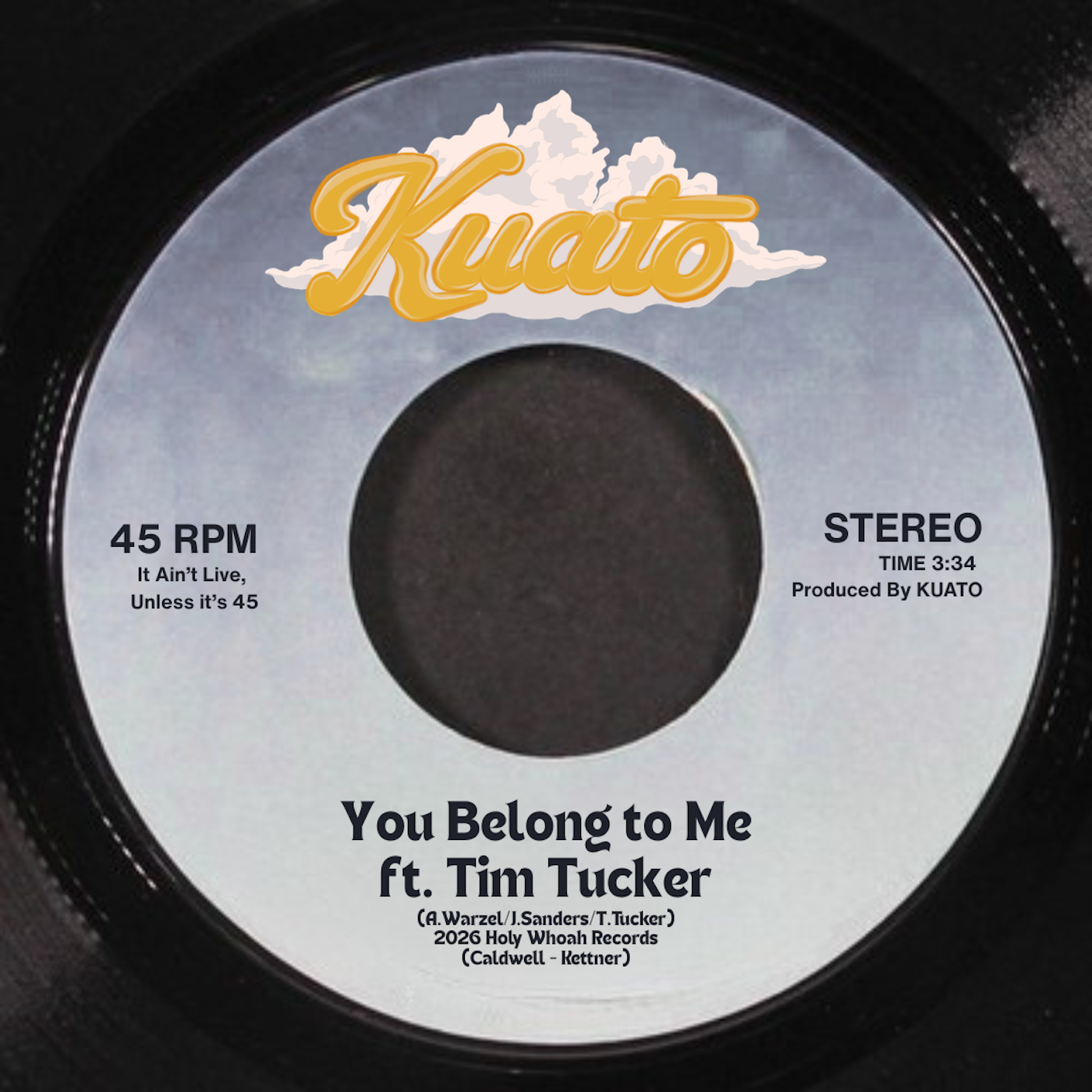
KUATO, the boogie duo I'm one half of, recently released a 7" record featuring our cover of Bobby Caldwell's "You Belong to Me" from his third album, Carry On.
The album contains more than a few gems. Tracks like "Carry On" sampled by MED and songs such as "Words" showcase the signature Caldwell sound: sophisticated songwriting, soulful grooves, and that unmistakable sense of cool. "You Belong to Me," however, is one of the deeper cuts in his catalog.
I go through phases where I become obsessed with a particular artist or album and spend months dissecting it. I've done this many times with Bobby Caldwell. I'll listen for hours, studying his phrasing, melodies, and songwriting, trying to understand what makes his music feel so effortless and satisfying.
The last time I went down that rabbit hole, I developed a real appreciation for "You Belong to Me."
It's not necessarily a song I'd play in a DJ set, but the bones of it are incredibly strong. The groove has a subtle darkness to it, a kind of swagger that makes you want to walk into a room and catch eyes and maybe fists. The synth stabs are fantastic, the guitar work is classic Caldwell, and, of course, there's his voice.
Like anyone who's spent time listening to Bobby Caldwell, I was captivated by his singing. The man sounds like an angel who probably smokes a pack a day and hangs out in places your mother wouldn't approve of. On this particular track, there are vocal harmonies that almost veer into '80s metal territory. It caught me completely off guard and left me wanting more.
For years, I've had a complicated relationship with cover songs.
I often wondered: if a song is already great, why cover it at all? Most artists choose songs they genuinely love. So if the original already accomplishes what it set out to do, what's the point of recreating it?
Over time, I've realized the answer lies in identifying both the genius and the weakness of a song.
"You Belong to Me" has both.
The songwriting, melodies, and vocal performance are classic Caldwell and can stand alongside the work of any heavyweight in popular music. At the same time, I felt the production, instrumentation, and tempo prevented the song from reaching its full potential. That's just my opinion, of course, but having that perspective gave me room to create a version with a life of its own.
When we approached this cover, I knew I wanted to make a modern boogie record, something built for contemporary dance floors and worthy of being pressed onto a 7".
That meant emphasizing a few key ingredients: heavier drums, a stronger groove, and bubbling synth textures.
Listening to the original, I could hear those elements hiding beneath the surface. The idea was there, but I wanted to push it further.
The original sits comfortably around 105 BPM, which works beautifully as a laid-back groove. But if your goal is to get a room moving during peak hours, it needs a little more urgency. After experimenting with several tempos, I landed on 113 BPM.
Finding the right tempo is more important than many people realize. Songs don't magically work at every speed. You have to test them, live with them, and let your instincts guide you. I initially tried 114 BPM, but it felt slightly rushed. At 113, the groove breathed properly.
From there, I dove into instrumentation.
Caldwell's version features some wonderful synth choices and signature guitar work, so I used those ideas as inspiration while building an entirely new sonic palette. Despite having countless presets saved, I rarely rely on old sounds when writing new music. The process of discovery is too important.
There's a song in your head. Don't cheat it.
If a sound doesn't feel right in your gut, it isn't right. Slow down. Spend time searching. Shape sounds until they become exactly what the song needs.
This habit drives my bandmate crazy.
We'll spend a session building parts only to throw them away the next time we meet. But more often than not, that's where the magic happens. The willingness to start over can be the difference between something that's merely good and something people genuinely connect with.
That said, there's a balance to maintain.
Overwork a song and you can squeeze the life out of it. You need enough patience to perfect the groove and texture, but enough restraint to preserve the spontaneity.
For anyone just starting out, one of the most important things you can develop is your own groove.
How do you naturally hear and feel funk? How do the drums and bass interact in your head? What kind of pocket feels authentic to you?
Funk has endless variations. Sly Stone doesn't groove like James Brown. The masters all found their own rhythmic language and committed to it. Your job is to find yours.
Once we had the groove and instrumentation in place, it was time for vocals.
This can be one of the hardest parts of making records. Every week I record vocal ideas that never see the light of day because I know they're not quite right. For this project, I called my friend Tim Tucker.
Tim is an OG in the world of funk and boogie. He's been making this music for decades and has a rich, soulful voice that immediately brings warmth and authority to a track. I loved the idea of contrasting his tone with Caldwell's while still honoring the spirit of the original performance.
Finally, if you're going to do a cover, bring something new to it.
Add a section. Change the arrangement. Write a new melody. Take a risk.
For our version of "You Belong to Me," we introduced a new ending section with fresh lyrics and a new melodic idea. Once the music was in place, I told Tim to follow his instincts and see where the song wanted to go.
The result was one of my favorite moments on the record.
That's ultimately what makes a cover worth doing, not recreating what's already there, but discovering something new hidden inside the original.